


We hope that what we have stated here on book printers is indeed inspiring to you, the reader. With this inspiration, learn even more about book printers.


Today's book printers Article
From The Battlefield To The Bookstore
For many reenactors, military and civilian, one of the pleasures of a weekend spent in the field is that elusive moment when everything works. I?ve heard the sensation called ?the bubble,? or simply ?the magic.? There?s no way to predict exactly when it will happen. The feeling may last only seconds. But once you?ve experienced a moment that suddenly looks, smells, sounds, and feels so real that you completely forget your modern existence, you?ll be hungry for more.
I know I am. After a decade of reenacting, I?m not able to participate much any more. Instead I read, disappearing into the magic of good historical novels. And I write historical fiction as well, a hobby-turned-career that lets me spend time in imaginary scenes of my own creation. My most recent novel, Hearts of Stone, grew out of a Civil War refugee camp scenario at an event in Tennessee. And one of those ?bubble? moments provided the kernel of raw inspiration.
Is there a novel in your future? If, like a number of reenactors I know, you?re interested in trying your hand at fiction, why wait until someday?
Reenactors are well poised to write historical fiction?much more so than many of the beginning writers I meet when I teach general workshops on the genre. As a serious reenactor, you?re already steeped in the history and social fabric of your chosen period. You know a lot about material culture and historical process. You?re experienced at traditional research, and you conduct experiential research every time you participate in a new event or try your hand at a new activity. And you probably have an innate sense of story. The things that you find most interesting about your hobby would likely make a strong foundation for a novel.
If you are ready to get to work, here are a few suggestions.
1. Develop a fresh story idea. If you want to write a children?s book about the Civil War, see how many stories about drummer boys exist before writing one of your own.
2. Once you?ve settled on your idea, focus first on writing your story, not publishing your novel. Enjoy the process. Take a class. Learn your craft. Let the marketing stuff come later.
3. Create a compelling, memorable main character. The best fiction is character-driven, so spend a lot of time thinking about the people you?ll be writing about. Develop a complete history for them. All the information won?t make it into the story, but it will help you present a complex, believable, consistent character.
4. Once you have a strong sense of your character, shape your plot. Think in terms of having your character struggle to achieve something. Short stories and books for young children may have one clear plotline. More complex novels have multiple plotlines. I like to think in terms of ?outer? and ?inner? struggles. In Hearts of Stone, my main character Hannah?s outer plot involves struggling to keep her family together after she and her younger siblings become orphaned and homeless during the Civil War. Her inner plot focuses on her emotional struggle to accept both her father?s decision to fight for the Union Army and her best friend?s support of the Confederacy.
5. Some writers outline their novels in advance; some don?t. Choose whatever approach works for you. I don?t outline, but I do build a graphic organizer as I go. I create a table with four headings across the top: Chapter, Date, Scenes, Historical Events. That helps me keep track of what my characters are doing, and how their actions fit into the actual timeline of events that form the backdrop for my story.
6. Research, of course, is essential and ongoing. The historical details we love can also bog down a novel?s pace. If you fall in love with some fact or process, don?t just describe it in your fiction. Use that information to help reveal something new about your character, or to advance your plot.
7. Also, decide in advance where you are going to draw the line on historical accuracy. Are you willing to fictionalize weather details, or to make up business names for the merchants in a particular town? Reenactors are often fanatical about getting the details right. At some point, you?ll have to say: Enough. I?m done.
8. Keep a journal when you are at events. With a well-chosen pencil and notebook, you can even make it part of your impression. Make a point of recording specific, sensory details. Those details will bring your fiction to life, and will signal to readers that you are a trustworthy narrator.
9. Read as many different primary accounts as possible. Becoming steeped in period literature of all kinds will help you impart the flavor of period-appropriate speech in your fiction. (Note I said ?flavor.? You don?t want to overwhelm readers with period-perfect but hard-to-understand speech.)
10. Join a professional writers? organization. Membership can be an excellent way to learn more about both writing and publishing. The groups? informative newsletters are often worth the price of membership. Most groups also hold regular conferences, which let pre-published authors meet other writers, agents and editors. The Historical Novel Society is an umbrella group for all historical fiction writers. Genre-specific groups like the Society of Children?s Book Writers and Illustrators, Mystery Writers of America, and Romance Writers of America may help you find professional success.
Once your story is as good as you can make it, you have options for publishing. If your top priority is creating a book that your family and friends can enjoy, sooner than later, you may want to self-publish. If your only dream is a book contract from a major publisher, hunker down for the long haul. Learn everything you can about the industry. Read what?s being published and make note of what different presses are looking for.
Having a book published is an amazing experience. Still, if someone told me that I?d never be published again, I wouldn?t stop writing. The process of researching, imagining, and writing my stories brings its own rewards. I hope you can find that magic as well.
About the Author:
Kathleen Ernst is a writer, social historian, and educator. She has written a dozen novels, including five set during the American Civil War. Her latest book is Hearts of Stone (Dutton, 2006). Learn more at http://www.kathleenernst.com
Featured book printers Items
The Swell Season

The Swell Season
Frames front man Hansard has teamed up with classically trained Czech vocalist and pianist, Irglova to produce this album of affecting songs and compositions. From straight songs to piano instrumentals, "The Swell Season" affords an insight into a whole other side of Glen/The Frames, as well as offering a perfect introduction to this very talented newcomer. The record takes its name from author Josef Skvorecky's book of the same name. Set in Nazi occupied Czechoslovakia, the story centers on one man's love of music and his pursuit of unattainable women as a country comes unglued. Like the book, the record deals with the pains and hopes of those struggling to make sense of their lives.
Customer Review: Can't stop listening to this music everty since I saw the movie "Once".
The movie "Once" is really great, the music from it even better. Glen Hansard in particular has a very moving emotional voice, Marketa Irglova is amazing. I can't wait for them to come Keller in April.
Customer Review: Once CD repeat
I love the Once soundtrack, but must agree that this CD is a disappointment and offers not enough new songs to purchase. If you've got the soundtrack, you've got enough.
Apple MacBook Pro MA895LL/A 15.4" Laptop (2.2 GHz Intel Core 2 Duo, 2 GB RAM, 120 GB Hard Drive, DVD/CD SuperDrive)

Apple MacBook Pro MA895LL/A 15.4" Laptop (2.2 GHz Intel Core 2 Duo, 2 GB RAM, 120 GB Hard Drive, DVD/CD SuperDrive)
Stylishly and intelligently designed for mobile professionals, Apple's MacBook Pro gets a serious speed bump with the new, powerful Intel chipset (dubbed Santa Rosa), which provides a faster Core 2 Duo processor, longer battery life, and native support for 802.11n wireless connectivity. This model (MA895LL/A) also includes a new mercury-free, power-efficient LED-backlit display measuring 15.4 inches and a state-of-the art NVIDIA GeForce 8600M GT video card for more realistic graphics for animation and gaming. This MacBook Pro is powered by the new 2.2 GHz Core 2 Duo T7500 processor and 2 GB of 667 MHz DDR2 memory--the fastest portable computer memory currently on the market (June 2007). But some things haven't changed: the trademark stunning aluminum enclosure that's is just one-inch thin, built-in iSight video camera, and Apple's magnetically connected MagSafe power adapter, which safely disconnects when under strain.
 This MacBook Pro measures just 1 inch thin and weighs 5.4 pounds. |
Intel Core 2 Duo Processor
The Intel Core 2 Duo T7500 processor has a 2.2 GHz processor speed, super-fast 800 MHz front-side bus (FSB), and an enormous 4 MB of Smart Cache, an L2 cache that can be shared between the cores as needed. (An L2, or secondary, cache temporarily stores data; and a larger L2 cache can help speed up your system's performance. The FSB carries data between the CPU and RAM, and a faster front-side bus will deliver better overall performance.)
The Intel Core 2 Duo's 128-bit SSE3 vector engine handles 128-bit computations in a single clock cycle, accelerating data manipulation by simultaneously applying a single instruction to multiple data. And its two execution cores are designed to share resources and conserve power, helping it to achieve higher levels of performance since it uses fewer watts
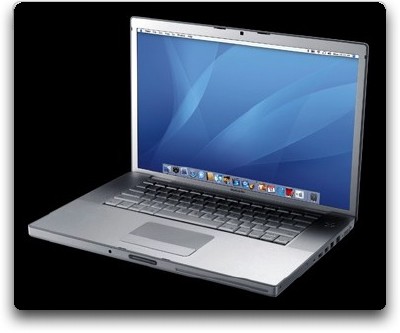 The new 15-inch MacBook Pro offers a new mercury-free, power-efficient LED-backlit display with an antiglare finish that's perfect for color-minded professionals. |
The 15.4-inch widescreen TFT (non-glossy) display offers a native resolution of 1440 x 900 pixels and an antiglare widescreen display that's perfect for color-minded professionals. The new MacBook Pro display is backlit by light emitting diodes (LEDs), which gives it a lighter weight and more power efficiency than the cold cathode fluorescent lamps (CCFLs) which most notebooks employ. It's also better for the environment, thanks to its new mercury-free display.
Video and graphics are powered by the NVIDIA GeForce 8600M GT card, which is boosted by 128 MB of GDDR3 SDRAM. GDDR3 (Graphics Double Data Rate, version 3) is a graphics card-specific memory technology that's better able to deliver fluid frame rates for even the most advanced games and applications. The GeForce 8600M GT brings a new level of realism to the MacBook Pro with its 16-lane PCI Express architecture, 16x full screen anti-aliasing, 128-bit High Dynamic Range rendering, and a texture fill rate of up to 8.2 billion per second.
Hard Drive and Memory
The 120 GB Serial-ATA (SATA) hard drive (5400 RPM) provides more than enough space to store business-related documents and presentations, as well as offers space for a large digital audio and video library. This SATA hard drive also quickens the pace with a higher speed transfer of data--akin to FireWire and USB 2.0. The 2 GB of PC5300 DDR2 RAM (two SO-DIMMs of 1 GB) have an industry-leading 667 MHz speed, and the RAM capacity can be increased to a whopping 4 GB.
Wireless Connectivity
The built-in 802.11n wireless networking provides up to five times the performance and twice the range of 802.11g, but it's also backward-compatible with 802.11a/b/g routers, enabling you to communicate with the a wide variety of Wi-Fi resources. It works seamlessly with the new AirPort Extreme with 802.11n. Use the built-in Bluetooth wireless technology to connect to your PDA or cell phone, synchronize addresses, or download pictures from your cell phone. You can also use a wireless headset for iChat audio chats and VoIP calls as well as quickly share files with a colleague.
Video Conferencing with Built-in iSight
Artfully placed in the display bezel is an iSight camera, which enables easy video conferencing as well as allows you to snap pictures of yourself and create video podcasts. Using the iChat AV application, video conferencing is integrated into your iChat buddy list, so initiating a video conference is a breeze. iChat also lets you hold audio chats with up to 10 people and provides high-quality audio compression and full-duplex sound so conversation can flow naturally. For video podcasting, you can record a short clip using the iSight camera, then use iWeb to create a video blog entry or post your GarageBand-recorded podcast.
Apple Innovations
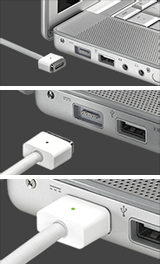 The magnetically connected MagSafe power adapter breaks cleanly away, without damage to either the cord or the MacBook Pro, if you trip over the cord.. |


This MacBook Pro measures just 1 inch thin and weighs 5.4 pounds. |
Intel Core 2 Duo Processor
The Intel Core 2 Duo T7500 processor has a 2.2 GHz processor speed, super-fast 800 MHz front-side bus (FSB), and an enormous 4 MB of Smart Cache, an L2 cache that can be shared between the cores as needed. (An L2, or secondary, cache temporarily stores data; and a larger L2 cache can help speed up your system's performance. The FSB carries data between the CPU and RAM, and a faster front-side bus will deliver better overall performance.)
The Intel Core 2 Duo's 128-bit SSE3 vector engine handles 128-bit computations in a single clock cycle, accelerating data manipulation by simultaneously applying a single instruction to multiple data. And its two execution cores are designed to share resources and conserve power, helping it to achieve higher levels of performance since it uses fewer watts
The new 15-inch MacBook Pro offers a new mercury-free, power-efficient LED-backlit display with an antiglare finish that's perfect for color-minded professionals. |
The 15.4-inch widescreen TFT (non-glossy) display offers a native resolution of 1440 x 900 pixels and an antiglare widescreen display that's perfect for color-minded professionals. The new MacBook Pro display is backlit by light emitting diodes (LEDs), which gives it a lighter weight and more power efficiency than the cold cathode fluorescent lamps (CCFLs) which most notebooks employ. It's also better for the environment, thanks to its new mercury-free display.
Video and graphics are powered by the NVIDIA GeForce 8600M GT card, which is boosted by 128 MB of GDDR3 SDRAM. GDDR3 (Graphics Double Data Rate, version 3) is a graphics card-specific memory technology that's better able to deliver fluid frame rates for even the most advanced games and applications. The GeForce 8600M GT brings a new level of realism to the MacBook Pro with its 16-lane PCI Express architecture, 16x full screen anti-aliasing, 128-bit High Dynamic Range rendering, and a texture fill rate of up to 8.2 billion per second.
Hard Drive and Memory
The 120 GB Serial-ATA (SATA) hard drive (5400 RPM) provides more than enough space to store business-related documents and presentations, as well as offers space for a large digital audio and video library. This SATA hard drive also quickens the pace with a higher speed transfer of data--akin to FireWire and USB 2.0. The 2 GB of PC5300 DDR2 RAM (two SO-DIMMs of 1 GB) have an industry-leading 667 MHz speed, and the RAM capacity can be increased to a whopping 4 GB.
Wireless Connectivity
The built-in 802.11n wireless networking provides up to five times the performance and twice the range of 802.11g, but it's also backward-compatible with 802.11a/b/g routers, enabling you to communicate with the a wide variety of Wi-Fi resources. It works seamlessly with the new AirPort Extreme with 802.11n. Use the built-in Bluetooth wireless technology to connect to your PDA or cell phone, synchronize addresses, or download pictures from your cell phone. You can also use a wireless headset for iChat audio chats and VoIP calls as well as quickly share files with a colleague.
Video Conferencing with Built-in iSight
Artfully placed in the display bezel is an iSight camera, which enables easy video conferencing as well as allows you to snap pictures of yourself and create video podcasts. Using the iChat AV application, video conferencing is integrated into your iChat buddy list, so initiating a video conference is a breeze. iChat also lets you hold audio chats with up to 10 people and provides high-quality audio compression and full-duplex sound so conversation can flow naturally. For video podcasting, you can record a short clip using the iSight camera, then use iWeb to create a video blog entry or post your GarageBand-recorded podcast.
Apple Innovations
The magnetically connected MagSafe power adapter breaks cleanly away, without damage to either the cord or the MacBook Pro, if you trip over the cord.. |


0 Comments:
Post a Comment
<< Home